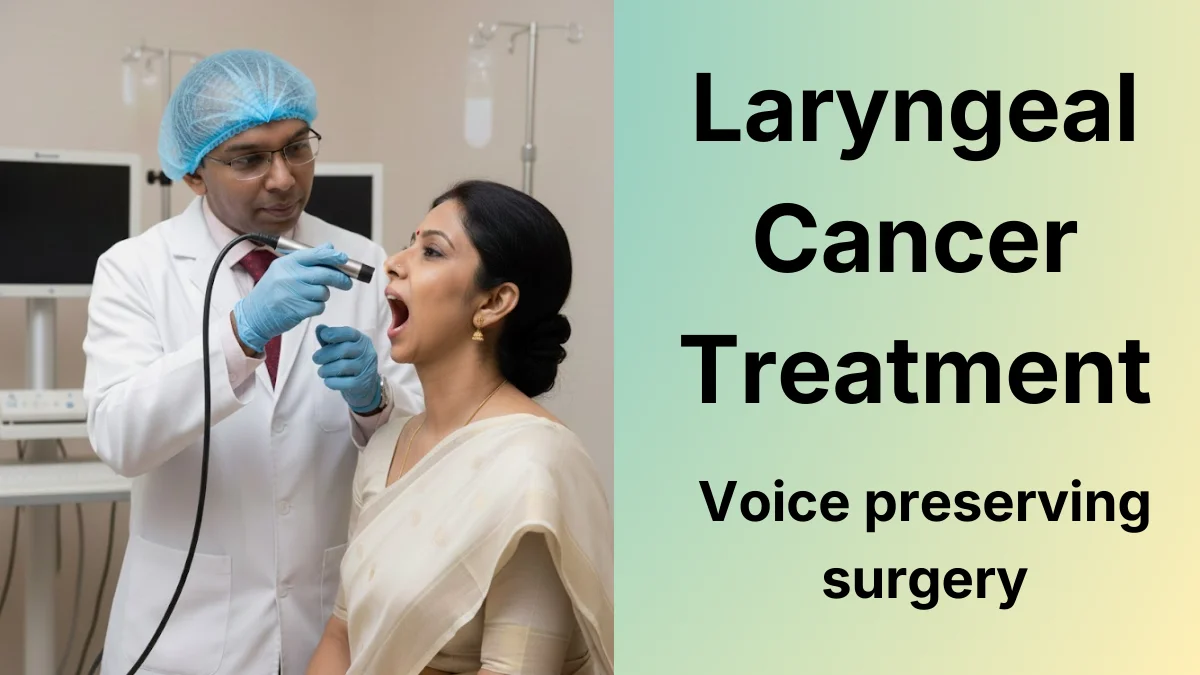
Laryngeal cancer, cancer of the voice box, is among the most common head and neck cancers in India, driven by the country's high rates of tobacco and alcohol use. Losing the ability to speak is often a patient's greatest fear upon diagnosis, but modern surgical advances have transformed what is possible. At THANC Hospital in Chennai, Dr. Vidhyadharan Sivakumar delivers the full spectrum of laryngeal cancer treatment, from voice-preserving Transoral Robotic Surgery (TORS) and laser cordectomy for early-stage disease to complex total laryngectomy with immediate voice rehabilitation for advanced cases. Having performed India's first TORS total laryngectomy in 2022, Dr. Vidhyadharan combines international training with deep expertise in preserving function while achieving oncologic cure.
Understanding Laryngeal Cancer
The larynx, or voice box, sits at the top of the trachea in the front of the neck. It produces voice through vibration of the vocal cords, protects the airway during swallowing, and serves as a breathing passageway. Laryngeal cancer develops when cells within the larynx undergo malignant transformation, almost always arising as squamous cell carcinoma from the mucosal lining.
India carries a disproportionately heavy burden of laryngeal cancer. GLOBOCAN data estimates 25,000-30,000 new cases annually in India, with incidence rates in Indian males well above the global average, driven by widespread tobacco consumption (bidis, cigarettes, chewing tobacco, paan with betel nut) and alcohol use. In Tamil Nadu specifically, the combination of smoking and alcohol creates a synergistic risk that multiplies the likelihood of developing laryngeal malignancy several-fold.
Detected early, laryngeal cancer is highly curable, 5-year survival exceeds 90% for Stage I glottic cancer. Yet many Indian patients present at advanced stages due to delayed recognition of symptoms. At THANC Hospital, Dr. Vidhyadharan emphasizes that any hoarseness persisting beyond three weeks, particularly in a tobacco or alcohol user, warrants urgent laryngoscopic examination.
Types and Staging
The larynx is divided into three regions, each influencing treatment strategy and prognosis:
Supraglottic cancer arises above the vocal cords (epiglottis, aryepiglottic folds, false cords). These tumors present later because hoarseness only occurs once they extend to the vocal cords, and they carry higher risk of lymph node metastasis (30-50% at presentation).
Glottic cancer originates from the true vocal cords, the most common subsite (~60-65% of cases). It causes hoarseness early, aiding detection, and nodal metastasis is uncommon in early stages due to sparse lymphatic drainage.
Subglottic cancer develops below the vocal cords. This rarest form (less than 5% of cases) tends to present at advanced stages.
Staging follows the AJCC/TNM system:
| Stage | Tumor Extent | Nodal Status | Treatment Approach | 5-Year Survival |
|---|---|---|---|---|
| I | Confined to one subsite, normal vocal cord mobility | No nodes | Voice-preserving surgery (TORS/TLM) or radiation | ~90% |
| II | Extends to adjacent subsite or impaired cord mobility | No nodes | Voice-preserving surgery or radiation | ~70-80% |
| III | Vocal cord fixation or limited extralaryngeal spread | Possible single ipsilateral node | Larynx-preserving protocol or surgery + adjuvant therapy | ~50-60% |
| IVA-B | Invasion through thyroid cartilage, surrounding structures | Multiple or bilateral nodes | Total laryngectomy + adjuvant chemoradiation | ~30-40% |
| IVC | Distant metastasis | Any | Systemic therapy, palliative care | Variable |
Understanding the precise stage is critical because it determines whether voice can be preserved. Dr. Vidhyadharan's detailed staging evaluation at THANC Hospital ensures that every patient receives the treatment approach best suited to their individual situation.
Causes and Risk Factors
The following risk factors are firmly established, many particularly relevant to Indian patients:
- Tobacco use: the single most important risk factor. Smoking cigarettes, bidis, or hookah exposes the laryngeal mucosa to carcinogens. Chewing tobacco and paan with betel nut also elevate risk. The risk is dose-dependent.
- Alcohol consumption: especially combined with tobacco, creating a multiplicative effect. Heavy users of both face 10-15 times the risk of non-users.
- GERD and laryngopharyngeal reflux: chronic acid irritation may contribute to malignant transformation.
- Occupational exposures: asbestos, wood dust, paint fumes, nickel, and sulfuric acid mist.
- HPV infection (HPV-16), increasingly recognized, though its role in laryngeal cancer is less established than in oropharyngeal cancer.
- Age and gender: predominantly affects men over 55 (male-to-female ratio ~7:1 in India).
- Poor nutrition: diets low in fruits, vegetables, vitamins A and E.
The critical message: tobacco cessation and alcohol moderation remain the most powerful preventive measures against laryngeal cancer.
Signs and Symptoms
Early recognition of laryngeal cancer symptoms can be the difference between a minimally invasive voice-preserving procedure and total laryngectomy. The symptoms vary by subsite:
Glottic cancer (most common):
- Persistent hoarseness or voice change lasting more than 3 weeks, this is the cardinal symptom
- Breathy or strained voice quality
- Vocal fatigue
Supraglottic cancer:
- Persistent sore throat or sensation of something stuck in the throat
- Difficulty or pain while swallowing (odynophagia)
- Referred ear pain (otalgia), pain felt in the ear despite a normal ear examination
- A muffled or "hot potato" voice quality
- A neck lump (lymph node enlargement) may be the first symptom
Advanced laryngeal cancer (any subsite):
- Progressive breathing difficulty or noisy breathing (stridor)
- Significant weight loss
- Persistent cough, sometimes with blood-streaked sputum
- Foul-smelling breath
- Fixed neck mass
If you are experiencing any of these warning signs, do not wait. Early evaluation can detect cancer at a stage where the voice can be saved. For a comprehensive overview, read our guide on understanding throat cancer symptoms.
Diagnosis at THANC Hospital
At THANC Hospital, Dr. Vidhyadharan follows a structured diagnostic pathway to achieve accurate staging efficiently:
- Flexible nasopharyngolaryngoscopy: a painless office procedure using a thin camera passed through the nose to visualize the entire larynx, assessing tumor location, extent, and vocal cord mobility.
- Videostroboscopy: provides slow-motion views of vocal cord vibration to assess invasion depth and candidacy for voice-preserving surgery.
- CT scan with contrast of the neck and chest to delineate tumor extent, cartilage involvement, lymph node status, and pulmonary metastasis.
- MRI of the larynx: used selectively for detailed soft tissue assessment, particularly pre-epiglottic space invasion or subtle cartilage involvement.
- PET-CT scan for advanced cancers to evaluate distant metastasis and detect synchronous primary tumors.
- Microlaryngoscopy and biopsy under general anesthesia for histopathological confirmation and detailed tumor mapping using angled endoscopes.
Every case undergoes multidisciplinary tumor board review involving the head and neck surgeon, radiation oncologist, medical oncologist, radiologist, pathologist, and speech-language pathologist, ensuring a consensus-driven, individualized treatment plan.
How Dr. Vidhyadharan Treats Laryngeal Cancer
Dr. Vidhyadharan's approach is guided by two principles: oncologic completeness (clear margins) and maximum functional preservation (voice, swallowing, and breathing). His MCh in Head and Neck Surgery from Amrita Institute, European Board Fellowship (FEB-ORL HNS), and FICRS certification in robotic surgery provide the foundation for this balanced approach.
Voice-Preserving Surgery for Early-Stage Cancer
Transoral Robotic Surgery (TORS) uses the da Vinci Xi system to resect laryngeal tumors through the mouth without external incisions. The 10x magnified 3D visualization and wristed instruments allow millimeter-precision tumor removal while preserving healthy tissue. TORS is particularly suited for supraglottic cancers and selected glottic tumors. Learn how the technology works in our guide on robotic surgery (TORS) explained.
Transoral Laser Microsurgery (TLM) uses a CO2 laser through an operating microscope to excise early glottic cancers. Laser cordectomy is the gold standard for T1 glottic cancer, offering cure rates of 85-95% with excellent voice preservation.
Open partial laryngectomy (vertical partial or supracricoid partial) removes the cancer-bearing portion while preserving enough structure for voice and airway protection, employed when endoscopic approaches are not feasible.
Surgery for Advanced-Stage Cancer
Total laryngectomy becomes necessary when cancer involves cartilage destruction, extralaryngeal spread, or fixed vocal cords with subglottic extension. Dr. Vidhyadharan's performance of India's first TORS total laryngectomy in 2022 demonstrated that even this complex procedure can be enhanced through robotic technology. The entire larynx is removed and the airway separated from the food passage. Patients breathe through a permanent stoma, but modern tracheoesophageal puncture (TEP) voice prosthesis placed during surgery allows most patients to regain functional speech.
Radiation, Chemoradiation, and Neck Dissection
For selected early glottic cancers (T1-T2), radiation therapy offers cure rates comparable to surgery. Dr. Vidhyadharan's published research in the European Journal of Surgical Oncology (2021) on economic evaluations comparing TORS and radiotherapy in oropharyngeal SCC contributes to the evidence base guiding these treatment decisions. For advanced cancers, adjuvant chemoradiation after surgery is standard when adverse pathological features are present. Supraglottic and advanced glottic cancers frequently require neck dissection, and Dr. Vidhyadharan performs nerve-sparing techniques that minimize shoulder dysfunction.
| Treatment Modality | Best Suited For | Voice Outcome | Hospital Stay | Recovery Time |
|---|---|---|---|---|
| Laser cordectomy (TLM) | T1 glottic cancer | Good to excellent | Day case or 1 night | 1-2 weeks |
| TORS resection | T1-T2 supraglottic, select glottic | Good to excellent | 2-4 days | 2-4 weeks |
| Open partial laryngectomy | T2-T3 where endoscopic not feasible | Moderate to good | 7-10 days | 4-6 weeks |
| Total laryngectomy | T3-T4 with cartilage invasion | TEP voice prosthesis | 10-14 days | 4-8 weeks |
| Radiation therapy (primary) | T1-T2 glottic | Good (risk of late fibrosis) | Outpatient (6-7 weeks) | 4-8 weeks post-treatment |
| Chemoradiation | Larynx preservation protocol (T3) | Variable | Outpatient + admissions | 8-12 weeks post-treatment |
What to Expect: Your Treatment Journey
Dr. Vidhyadharan and the THANC Hospital team guide patients through a structured pathway:
Week 1, Initial evaluation: Clinical examination, flexible laryngoscopy, and imaging. Results are typically available within 3-5 working days.
Week 2, Tumor board and counseling: Your case is presented to the multidisciplinary tumor board. Dr. Vidhyadharan discusses all options, outcomes, and the recommended approach. Patients are encouraged to bring family members.
Week 2-3, Pre-operative preparation: Pre-anesthesia assessment, blood work, cardiac clearance if needed, and a pre-operative meeting with the speech-language pathologist to establish baseline voice and swallowing function.
Surgery and hospital stay: Laser cordectomy may be a day procedure. TORS patients typically stay 2-4 days. Total laryngectomy patients remain 10-14 days for wound monitoring, stoma management, and early rehabilitation.
Post-discharge follow-up: Visits at 2 weeks, 6 weeks, 3 months, then every 3 months for two years, every 6 months for years 3-5, and annually thereafter, including laryngoscopy, imaging, and speech-language pathology support.
Recovery and Voice Rehabilitation
Recovery varies by procedure, but THANC Hospital's integrated rehabilitation programme begins before surgery and continues for as long as needed.
After laser cordectomy or TORS: Voice rest for 3-7 days, followed by graduated voice use under speech-language pathology guidance. Voice improves steadily over 4-8 weeks, and most patients return to work within 2-4 weeks.
After partial laryngectomy: A temporary tracheostomy may be needed for 1-2 weeks. Swallowing rehabilitation begins once healing is confirmed. Voice quality is altered but functional, with continued improvement over 2-3 months.
After total laryngectomy, rehabilitation focuses on three areas:
- Voice restoration: Dr. Vidhyadharan performs primary tracheoesophageal puncture (TEP) with voice prosthesis at the time of surgery whenever possible, allowing speech within 2-3 weeks. Alternatives include esophageal speech and electrolarynx.
- Stoma care: Patients learn tracheostoma management, including humidification and use of heat-moisture exchangers (HMEs).
- Swallowing: Generally well preserved after total laryngectomy since the airway is permanently separated from the food passage. Normal oral diet resumes within 10-14 days.
The speech-language pathology team provides dedicated laryngectomy rehabilitation, including peer support groups.
Outcomes and Prognosis
Outcomes depend on stage at diagnosis, treatment modality, and surgical expertise:
- Stage I glottic cancer: Local control 85-95%, 5-year survival ~90%.
- Stage II: 5-year survival 70-80%, voice preservation viable for most patients.
- Stage III: 5-year survival 50-60% with organ-preservation protocols or surgery plus adjuvant therapy.
- Stage IV: 5-year survival 30-40%, but durable local control is achievable with aggressive multimodal treatment.
Key prognostic factors include early detection, clear surgical margins, treatment by a high-volume surgeon, and adherence to adjuvant therapy. Dr. Vidhyadharan's 3000+ head and neck surgeries reflect the kind of volume that published literature consistently associates with better outcomes. Patients treated with voice-preserving surgery at THANC Hospital report high satisfaction, with the majority maintaining intelligible speech and functional swallowing. Those who undergo total laryngectomy with TEP voice restoration and comprehensive rehabilitation return to productive social and professional lives.
Why Choose Dr. Vidhyadharan at THANC Hospital
Choosing the right surgeon is one of the most consequential decisions a laryngeal cancer patient will make. Dr. Vidhyadharan Sivakumar offers a combination of training, expertise, and infrastructure that is difficult to match:
- India's first TORS total laryngectomy (2022): a landmark in robotic head and neck surgery.
- European Board certification (FEB-ORL HNS): among the few head and neck surgeons in India with this credential.
- FICRS, Fellow, Indian College of Robotic Surgeons: fellowship training at Royal Adelaide Hospital, Australia.
- MCh (Head & Neck Surgery), Amrita Institute of Medical Sciences: India's premier super-specialty programme.
- MS (ENT) Gold Medal, Annamalai University: academic excellence from the foundation.
- Published research in EJSO (2021) comparing TORS and radiotherapy outcomes.
- 3000+ head and neck surgeries: the volume that evidence links to better outcomes.
THANC Hospital provides the matching infrastructure: da Vinci Xi robotic system, dedicated head and neck theatres, in-house speech-language pathology, and a multidisciplinary oncology team. As a specialized head and neck cancer centre, every process is designed around the needs of patients with laryngeal and other head and neck cancers.
For patients seeking a voice-preserving approach to laryngeal cancer, early consultation is the single most important step. The earlier the cancer is detected and staged, the greater the range of treatment options available, and the higher the likelihood of preserving the voice.
Treatment Cost and Insurance
Treatment costs in Chennai vary based on cancer stage, procedure type, reconstruction needs, room category, and hospital stay duration.
- Laser cordectomy is the least costly, often performed as a day procedure.
- TORS procedures add robotic system costs, but shorter hospital stays and faster recovery often offset the difference.
- Total laryngectomy with TEP reflects longer hospitalization, possible reconstruction, voice prosthesis, and rehabilitation.
Insurance: Most major health insurance providers in India cover laryngeal cancer treatment as a listed oncological condition, including cashless treatment at empanelled hospitals. THANC Hospital's patient relations team assists with pre-authorization and documentation.
Government schemes: Eligible patients may access subsidized treatment through Ayushman Bharat (AB-PMJAY) or the Tamil Nadu Chief Minister's Comprehensive Health Insurance Scheme (CMCHIS).
THANC Hospital provides transparent cost estimates during your initial consultation, tailored to your specific condition and treatment plan. No patient should delay evaluation due to cost concerns, early treatment is less complex, less costly, and leads to better outcomes.
To schedule a consultation with Dr. Vidhyadharan Sivakumar, call +91 73059 53378 or request an appointment online.