Chennai's Expert Tongue Cancer Surgeon

Dr. Vidhyadharan Sivakumar is a fellowship-trained head and neck surgical oncologist specializing in tongue cancer treatment. His landmark case studies published in international journals demonstrate how robotic surgery (TORS) avoids jaw-splitting procedures even for complex tongue base cancers—preserving speech, swallowing, and appearance.

With training from Royal Adelaide Hospital (Australia) and expertise in Transoral Robotic Surgery, Dr. Vidhyadharan offers minimally invasive approaches for tongue cancer that were previously only treatable with disfiguring open surgery. As Clinical Director at THANC Hospital, he leads a multidisciplinary team providing comprehensive tongue cancer care.

Credentials & Expertise

Published research on TORS for tongue cancer | 40+ peer-reviewed publications | MCh Head & Neck Surgery (Gold Medal) | 3000+ surgeries | Rising Star Award in Onco-Phagosurgery

Tongue Cancer Conditions Treated

Oral Tongue Cancer (Anterior 2/3)
Base of Tongue Cancer (Posterior 1/3)
Lateral Tongue Cancer
Tongue Tip Cancer
Floor of Mouth Cancer with Tongue Involvement
Tongue Leukoplakia (Pre-cancerous)
Tongue Erythroplakia
HPV-Related Tongue Base Cancer
Recurrent Tongue Cancer
Locally Advanced Tongue Cancer
Tongue Cancer with Neck Metastasis
Second Primary Tongue Cancer

Warning Signs of Tongue Cancer

Consult Dr. Vidhyadharan if you experience:

Non-healing ulcer on tongue lasting more than 3 weeks
Persistent tongue pain
White or red patch on tongue
Lump or thickening on tongue
Difficulty moving tongue
Speech changes or slurred speech
Difficulty swallowing
Tongue numbness
Bleeding from tongue
Ear pain (referred pain)
Neck lump
Unexplained weight loss

Early diagnosis improves outcomes

Treatments

Dr. Vidhyadharan's Tongue Cancer Treatment Approaches

Transoral Robotic Surgery (TORS)

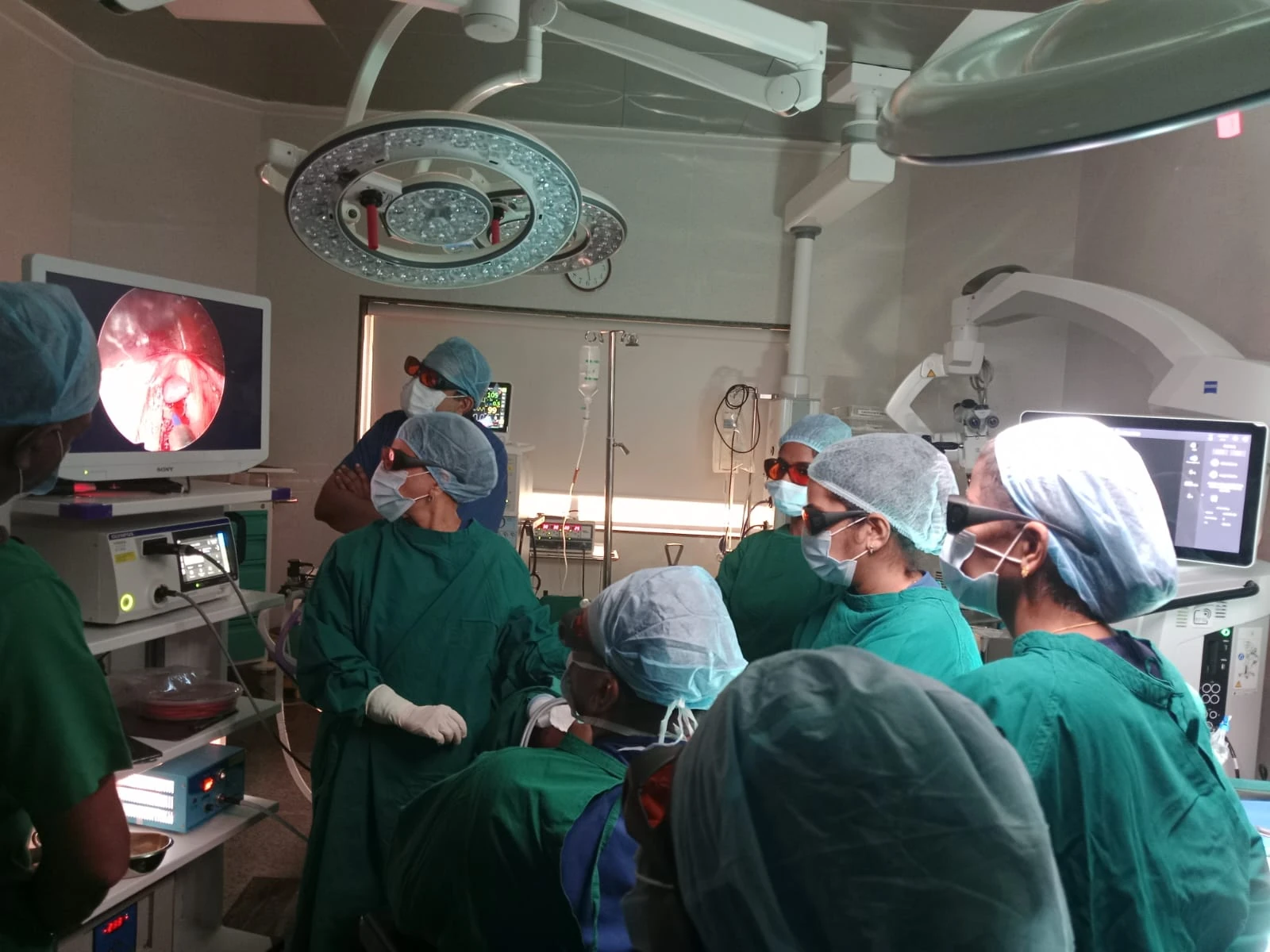
Revolutionary approach for base of tongue cancers. The da Vinci robot provides 3D magnified vision and precise instruments to remove tumors through the mouth without jaw-splitting. Dr. Vidhyadharan's published research demonstrates excellent outcomes with TORS for tongue base cancers.

Laser Excision (TLM)

Precision laser surgery for early oral tongue cancers. Minimal bleeding, precise margins, and excellent healing. Ideal for small superficial tumors. Often performed as day surgery with quick return to normal eating and speaking.

Partial Glossectomy with Reconstruction

For larger tongue cancers, removal of the involved portion with immediate reconstruction using local flaps or free tissue transfer. Dr. Vidhyadharan's reconstructive expertise ensures tongue mobility and function are preserved for speech and swallowing.

Neck Dissection

Tongue cancer commonly spreads to neck lymph nodes. Selective or comprehensive neck dissection removes at-risk nodes. Nerve-sparing techniques preserve shoulder function. Often performed simultaneously with tongue surgery.

Why Choose

Why Choose Dr. Vidhyadharan for Tongue Cancer

Published research on TORS for tongue base cancer in international journals

Fellowship training in robotic surgery from Royal Adelaide Hospital, Australia

MCh in Head & Neck Surgery with Gold Medal from Amrita Institute

Over 3000 head and neck surgeries performed

Expertise avoids jaw-splitting even for complex tongue cancers

Microvascular reconstruction for optimal function

Top Downloaded Paper Award from The Laryngoscope (2018-2019)

Comprehensive speech and swallowing rehabilitation

Advanced Technology & Techniques

da Vinci Robotic Surgical SystemCO2 Laser SurgeryNarrow Band Imaging (NBI)Intraoperative Frozen SectionMicrovascular Surgical EquipmentHigh-Definition Endoscopy
Your Journey

Your Tongue Cancer Treatment Journey

Understanding what to expect helps reduce anxiety and prepares you for treatment

1

Comprehensive Evaluation

Detailed oral examination with biopsy. Staging with MRI (best for tongue tumors), CT, and PET scan. Assessment of speech and swallowing baseline. Dental evaluation for treatment planning.

2

Multidisciplinary Planning

Tumor board discussion with surgeons, radiation oncologists, medical oncologists, and reconstructive surgeons. Selection of optimal approach: TORS, laser, partial glossectomy, or combined treatment.

3

Surgical Treatment

Precise tumor removal with adequate margins. TORS for base of tongue without jaw-splitting. Reconstruction for larger defects to maintain tongue bulk and mobility. Simultaneous neck dissection when indicated.

4

Post-Operative Care

Airway monitoring and management. Early swallowing evaluation. Nasogastric or gastrostomy feeding if needed temporarily. Wound care and flap monitoring for reconstructive cases.

5

Rehabilitation & Follow-Up

Intensive speech and swallowing therapy. Dietary progression from soft to regular foods. Dental rehabilitation if needed. Regular surveillance for recurrence detection. Long-term functional optimization.

FAQs

Frequently Asked Questions

Oral tongue cancer is primarily caused by tobacco use (smoking and chewing) and alcohol. Betel nut/paan chewing is a major cause in India. Base of tongue cancer is increasingly caused by HPV (Human Papillomavirus) infection, even in non-smokers. Poor oral hygiene and chronic irritation also contribute.

Speech outcomes depend on tumor size and location. For small tumors treated with laser or limited resection, speech is usually normal. Larger resections may affect speech clarity, but reconstruction and speech therapy help significantly. Even after major tongue surgery, most patients develop understandable speech with therapy.

Very small, superficial cancers may be treated with laser ablation with minimal tissue loss. However, most tongue cancers require surgical excision with margins to ensure complete removal. Dr. Vidhyadharan's minimally invasive techniques remove only what's necessary while preserving maximum function.

For base of tongue cancers, TORS offers tremendous advantages: surgery through the mouth avoids mandible (jaw) splitting, no external incisions, better swallowing outcomes, shorter hospital stay, and often reduces need for post-operative radiation. Dr. Vidhyadharan's published research demonstrates these benefits.

Tongue cancer staging considers tumor size (T1-T4), lymph node involvement (N0-N3), and distant spread (M0-M1). Depth of invasion is now an important factor for oral tongue cancer. Staging guides treatment decisions. Dr. Vidhyadharan uses advanced imaging including MRI and PET-CT for accurate staging.

Early tongue cancer (Stage I-II) has excellent survival rates of 70-90%. Advanced tongue cancer survival is 40-60% but has improved with modern treatment. HPV-positive base of tongue cancer has better prognosis than HPV-negative. Dr. Vidhyadharan's expertise in comprehensive treatment optimizes outcomes.

It depends on pathology findings. Early-stage cancers with clear margins often need surgery alone. Post-operative radiation is recommended for advanced tumors, close/positive margins, lymph node involvement, or perineural invasion. The tumor board makes individualized recommendations.

Recovery varies by procedure. Laser excision: few days, often outpatient. TORS: 3-5 days hospital stay, 2 weeks recovery. Partial glossectomy with reconstruction: 1-2 weeks hospital, 4-6 weeks recovery. Swallowing may need 2-3 months to fully normalize with therapy.

Most patients return to normal or near-normal eating. Small tumor resections barely affect eating. Larger resections may initially require soft diet, but with reconstruction and swallowing therapy, most progress to regular diet. Some texture modifications may be needed for very large resections.

Oral tongue (front 2/3) cancers are usually from tobacco/alcohol, present as visible ulcers, and are treated surgically through the mouth. Base of tongue (back 1/3) cancers are often HPV-related, present with throat symptoms, and require specialized approaches like TORS. Dr. Vidhyadharan treats both types with appropriate techniques.

Cost depends on tumor extent, surgical approach (laser, TORS, or reconstruction), hospital stay, and adjuvant treatment needs. THANC Hospital offers comprehensive tongue cancer care with transparent pricing. Insurance coverage is available. Detailed estimates provided after staging workup.

Any tongue ulcer lasting more than 3 weeks needs evaluation. While most ulcers are benign (traumatic, aphthous), persistent ulcers can be cancer, especially if painless, indurated, or in high-risk individuals (tobacco users). Dr. Vidhyadharan can perform examination and biopsy for definitive diagnosis.

Have more questions? We're here to help.

Schedule a Consultation

Function-Preserving Tongue Cancer Care - Consult Dr. Vidhyadharan

Expert in minimally invasive tongue cancer surgery that preserves speech and swallowing. Schedule your consultation at THANC Hospital Chennai