Neck Lump: When to Worry, What Tests You Need & Next Steps
Need expert consultation? Book an appointment with Dr. Vidhyadharan at THANC Hospital.
Book AppointmentDiscovering a neck lump can be alarming, triggering immediate concerns about serious underlying conditions. At THANC Hospital, Kilpauk, Chennai, Dr. Vidhyadharan Sivakumar, a fellowship-trained head and neck surgeon with 3000+ complex surgeries, provides expert evaluation and treatment for all types of neck lumps. This comprehensive guide aims to provide clarity on when a neck lump warrants concern and when to seek specialist care. For a structured assessment, see our dedicated page on neck lump evaluation.
Understanding the potential causes and knowing the warning signs can empower you to make informed decisions about your health. Dr. Vidhyadharan notes that patients often present with anxiety about a newly discovered neck lump, and a thorough evaluation can provide reassurance or initiate prompt and effective treatment.
Understanding Neck Lumps: Common Causes and Characteristics
A neck lump, also known as a neck mass, can arise from various sources. Differentiating between these causes is the first step toward appropriate management.
1. Swollen Lymph Nodes (Lymphadenopathy)
Swollen lymph nodes are the most common cause of neck lumps. Lymph nodes are small, bean-shaped structures that filter lymph fluid, a clear fluid containing white blood cells that help fight infection. When the body is fighting an infection, lymph nodes can become enlarged and tender.
- Causes: Common colds, flu, strep throat, ear infections, tonsillitis, mononucleosis (mono), and skin infections.
- Characteristics: Usually soft, mobile, and tender to the touch. Often accompanied by other symptoms of infection, such as fever, sore throat, or runny nose. Typically resolve within a few weeks as the infection clears.
2. Thyroid Nodules
The thyroid gland, located at the base of the neck, produces hormones that regulate metabolism. Thyroid nodules are lumps within the thyroid gland. Most thyroid nodules are benign, but a small percentage can be cancerous.
- Causes: Benign cysts, thyroiditis (inflammation of the thyroid), multinodular goiter, or, less commonly, thyroid cancer.
- Characteristics: Can be single or multiple, soft or firm. Often asymptomatic, but larger nodules can cause difficulty swallowing or breathing.
3. Salivary Gland Tumors
The salivary glands produce saliva, which helps with digestion. Tumors can develop in the salivary glands, most commonly in the parotid gland, located in front of the ear.
- Causes: Benign tumors are more common than malignant (cancerous) tumors. Risk factors for malignant tumors include radiation exposure and certain genetic syndromes.
- Characteristics: Usually a slow-growing, painless lump in the cheek or under the jaw. May cause facial nerve weakness or numbness if the tumor is malignant and involves the facial nerve.
4. Cysts
Cysts are fluid-filled sacs that can develop in the neck.
- Causes: Branchial cleft cysts (congenital cysts that form during embryonic development), thyroglossal duct cysts (cysts that form along the path of the thyroid gland during development), or epidermal cysts (cysts that form from blocked hair follicles).
- Characteristics: Usually soft, mobile, and painless. May become infected and tender.
5. Lipomas
Lipomas are benign tumors composed of fat cells.
- Causes: Genetic predisposition or unknown factors.
- Characteristics: Soft, rubbery, and painless lump under the skin.
6. Head and Neck Cancer
In some cases, a neck lump can be a sign of head and neck cancer, which includes cancers of the throat, tongue, oral cavity, larynx (voice box), and other areas of the head and neck. Dr. Vidhyadharan emphasizes that early detection is key to successful treatment.
- Causes: Tobacco use, excessive alcohol consumption, human papillomavirus (HPV) infection, and certain genetic factors.
- Characteristics: Usually a hard, fixed, and painless lump. May be accompanied by other symptoms, such as a persistent sore throat, difficulty swallowing, hoarseness, or unexplained weight loss.
When is a Neck Lump Cause for Concern? Red Flags to Watch For
While most neck lumps are benign, certain characteristics warrant prompt medical evaluation. Pay attention to the following red flags:
- Persistence: A lump that persists for more than two to three weeks without any signs of improvement.
- Hardness: A hard or firm lump, especially if it is fixed and does not move easily.
- Painlessness: A painless lump, particularly if it is growing in size.
- Rapid Growth: A lump that is rapidly increasing in size.
- Associated Symptoms: The presence of other symptoms, such as:
- Persistent sore throat
- Difficulty swallowing (dysphagia)
- Hoarseness or change in voice
- Unexplained weight loss
- Night sweats
- Fever without an obvious cause
- Ear pain
- Difficulty breathing
- Risk Factors: A history of tobacco use, excessive alcohol consumption, or HPV infection.
- Age: While neck lumps can occur at any age, they are more likely to be cancerous in older adults.
If you experience any of these red flags, it is crucial to consult with a healthcare professional for prompt evaluation and diagnosis. Book an appointment with Dr. Vidhyadharan at THANC Hospital, Chennai, or call +91 73059 53378.
Diagnostic Procedures for Neck Lumps
To determine the cause of a neck lump, your doctor may recommend one or more of the following diagnostic procedures:
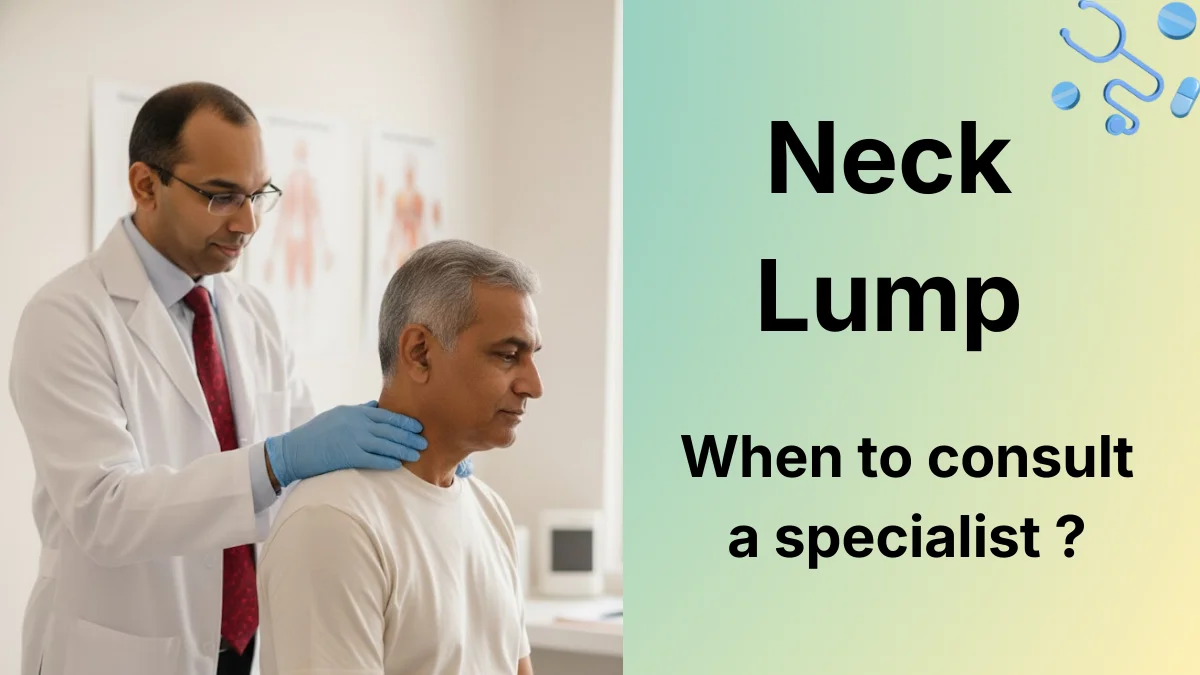
- Physical Examination: A thorough examination of the neck and surrounding areas, including the lymph nodes, thyroid gland, and salivary glands.
- Medical History: A review of your medical history, including any relevant risk factors, such as tobacco use or HPV infection.
- Fine Needle Aspiration (FNA) Biopsy: A procedure in which a thin needle is used to collect a sample of cells from the lump for microscopic examination. This is a common and effective method for evaluating thyroid nodules and suspicious lymph nodes.
- Imaging Studies:
- Ultrasound: A non-invasive imaging technique that uses sound waves to create images of the neck structures. Useful for evaluating thyroid nodules and lymph nodes.
- CT Scan (Computed Tomography): A more detailed imaging technique that uses X-rays to create cross-sectional images of the neck. Helpful for evaluating larger neck masses and assessing the extent of any potential cancer.
- MRI (Magnetic Resonance Imaging): Another detailed imaging technique that uses magnetic fields and radio waves to create images of the neck. Particularly useful for evaluating soft tissue structures, such as salivary glands and muscles.
- PET/CT Scan (Positron Emission Tomography/Computed Tomography): A nuclear medicine imaging technique that combines PET and CT scans to detect metabolically active cells, such as cancer cells. Used to stage cancer and assess treatment response.
- Laryngoscopy: Examination of the larynx (voice box) using a flexible or rigid scope. This is particularly important if you have hoarseness or difficulty swallowing.
- Open Biopsy: In some cases, an open biopsy may be necessary to obtain a larger tissue sample for diagnosis. This involves surgically removing a portion of the lump.
Treatment Options for Neck Lumps
The treatment for a neck lump depends on the underlying cause.
1. Observation
For benign neck lumps, such as swollen lymph nodes due to a common cold, observation may be the only treatment necessary. The lump will typically resolve on its own as the infection clears.
2. Antibiotics
If the neck lump is caused by a bacterial infection, antibiotics will be prescribed.
3. Surgery
Surgery may be necessary for:
- Thyroid Nodules: To remove suspicious or cancerous nodules. Dr. Vidhyadharan Sivakumar specializes in Thyroid & Parathyroid Surgery.
- Salivary Gland Tumors: To remove benign or malignant tumors.
- Cysts: To remove cysts that are causing symptoms or are at risk of becoming infected.
- Head and Neck Cancer: To remove cancerous tumors and affected lymph nodes. Dr. Vidhyadharan is an expert in Head & Neck Cancer Surgery. He is also one of the few surgeons in India trained in Transoral Robotic Surgery (TORS) using the da Vinci Robotic System, a minimally invasive approach for treating certain head and neck cancers.
4. Radiation Therapy
Radiation therapy may be used to treat head and neck cancer, either alone or in combination with surgery and chemotherapy.
5. Chemotherapy
Chemotherapy may be used to treat head and neck cancer, either alone or in combination with surgery and radiation therapy.
6. Targeted Therapy
Targeted therapy drugs target specific molecules involved in cancer growth and spread. These drugs may be used to treat certain types of head and neck cancer.
7. Immunotherapy
Immunotherapy drugs help the body's immune system fight cancer. These drugs may be used to treat certain types of head and neck cancer.
| Treatment Option | Description |
|---|---|
| Observation | Monitoring the lump without active intervention, suitable for benign conditions. |
| Antibiotics | Medication to treat bacterial infections causing lymph node swelling. |
| Surgery | Removal of the lump, necessary for suspicious or cancerous nodules, salivary gland tumors, cysts, and head and neck cancers. Dr. Vidhyadharan specializes in minimally invasive techniques like TORS. |
| Radiation Therapy | Using high-energy rays to kill cancer cells, often used in combination with surgery and chemotherapy. |
| Chemotherapy | Using drugs to kill cancer cells, often used in combination with surgery and radiation therapy. |
| Targeted Therapy | Using drugs that target specific molecules involved in cancer growth, used for certain types of head and neck cancers. |
| Immunotherapy | Using drugs that help the body's immune system fight cancer, used for certain types of head and neck cancers. |
Living with a Neck Lump: Tips for Self-Care and Monitoring
While awaiting diagnosis or undergoing treatment, there are several steps you can take to manage your condition:
- Monitor the Lump: Regularly check the size, shape, and consistency of the lump. Note any changes and report them to your doctor.
- Pain Management: If the lump is painful, you can take over-the-counter pain relievers, such as ibuprofen or acetaminophen.
- Warm Compresses: Applying warm compresses to the affected area can help reduce swelling and pain.
- Avoid Irritants: Avoid smoking and excessive alcohol consumption, as these can irritate the throat and worsen symptoms.
- Stay Hydrated: Drink plenty of fluids to keep your throat moist and comfortable.
- Rest: Get adequate rest to allow your body to heal.
- Maintain a Healthy Diet: Eat a balanced diet to support your immune system.
- Seek Emotional Support: Dealing with a neck lump can be stressful. Seek support from family, friends, or a therapist.
Prevention of Neck Lumps
While not all neck lumps can be prevented, there are steps you can take to reduce your risk:
- Quit Smoking: Smoking is a major risk factor for head and neck cancer.
- Limit Alcohol Consumption: Excessive alcohol consumption is also a risk factor for head and neck cancer.
- Get Vaccinated Against HPV: HPV infection is a risk factor for certain types of head and neck cancer.
- Practice Good Hygiene: Wash your hands frequently to prevent infections that can cause swollen lymph nodes.
- Avoid Exposure to Radiation: Exposure to radiation can increase the risk of thyroid cancer and salivary gland tumors.
The Importance of Early Detection and Expert Care
Early detection is crucial for successful treatment of neck lumps, especially if they are cancerous. If you notice a neck lump that persists for more than a few weeks or has any of the red flag characteristics mentioned above, it is essential to seek prompt medical evaluation from a qualified head and neck specialist like Dr. Vidhyadharan Sivakumar.
Dr. Vidhyadharan Sivakumar is an internationally trained Head & Neck Surgical Oncologist with extensive experience in diagnosing and treating a wide range of neck lumps, including head and neck cancers, thyroid nodules, and salivary gland tumors. He is the Clinical Director & Senior Consultant at THANC Hospital (The Head and Neck Centre & Hospital) in Kilpauk, Chennai. His qualifications include:
- MCh (Head & Neck Surgery) - Amrita Institute
- MS (Otorhinolaryngology) - Gold Medal, First Mark - Annamalai University (2009)
- ASOHNS Clinical Fellowship - Royal Adelaide Hospital, Australia (2016-17)
- Fellow, European Board of Otorhinolaryngology (FEB-ORL HNS, 2018)
- Fellow, Indian College of Robotic Surgeons (FICRS)
- Co-Editor of "Comprehensive Management of Head and Neck Cancer" (Jaypee Brothers, 2021)
- 40+ peer-reviewed publications including The Laryngoscope
- 15+ years specialist practice | 3000+ complex surgeries
For personalized treatment options and expert care, consult Dr. Vidhyadharan Sivakumar at THANC Hospital, Kilpauk, Chennai. Call +91 73059 53378 or request an appointment online.
Related Reading
- Thyroid Nodules: Causes, Symptoms, and Treatment
- Head and Neck Cancer Survival Rates: Modern Treatment
- Oral Cancer Warning Signs and Symptoms in India
References
- National Cancer Institute. "Head and Neck Cancers." https://www.cancer.gov/types/head-and-neck
- American Cancer Society. "Signs and Symptoms of Head and Neck Cancers." https://www.cancer.org/cancer/types/head-neck-cancer/detection-diagnosis-staging/signs-and-symptoms.html
- NCCN Guidelines. "Head and Neck Cancers." https://www.nccn.org/guidelines/category_1
- The Laryngoscope. "Transoral Robotic Surgery for Head and Neck Cancer: A Systematic Review." 2010.
- Mayo Clinic. "Swollen Lymph Nodes." https://www.mayoclinic.org/diseases-conditions/swollen-lymph-nodes/symptoms-causes/syc-20354318
- American Thyroid Association. "Thyroid Nodules." https://www.thyroid.org/thyroid-nodules/
- World Health Organization. "Cancer." https://www.who.int/news-room/fact-sheets/detail/cancer

Authored by
Dr. Vidhyadharan Sivakumar
MCh (Head & Neck Surgery), FEB-ORL HNS, MS (ENT) Gold Medal
Clinical Director & Senior Consultant at THANC Hospital, Chennai. Co-Editor of "Comprehensive Management of Head and Neck Cancer" (2021) with 40+ publications. Team Leader for India's first TORS-assisted Total Laryngectomy (2022). 15+ years experience with over 3000 complex surgeries.