A swelling under the jaw that comes and goes, especially around meals, is a common reason patients are referred to a salivary gland specialist. It often comes from the submandibular gland, one of the major salivary glands. When the gland holds a tumour, a stone that cannot be cleared in a gland-sparing way, or repeated infections, the best treatment is usually to remove the gland. At THANC Hospital in Chennai, Dr. Vidhyadharan Sivakumar performs submandibular gland excision through a small, well-hidden neck incision, with careful protection of the nerves that move the lip and the tongue.
Understanding the Submandibular Gland
You have two submandibular glands, one on each side, sitting just under the jaw. They make a large share of your saliva and drain it into the floor of the mouth through a narrow duct. Because this duct runs uphill, the gland is prone to stones, which can block the flow and cause painful swelling at mealtimes.
Three important nerves run close to the gland. One moves the lower lip, one carries sensation and taste for the tongue, and one moves the tongue. Protecting these nerves is the central part of safe surgery here.
When the Gland Needs to Be Removed
Removal is usually advised for one of these reasons:
- A tumour or lump in the gland that needs to be removed and examined.
- Stones that are large, multiple, or sit deep in the gland and cannot be cleared while keeping the gland.
- Repeated infection or swelling in a gland that no longer drains well.
Removing one submandibular gland does not cause a dry mouth, because the other salivary glands make plenty of saliva.
Signs and Symptoms
The usual signs include:
- A swelling or lump under the jaw, sometimes worse around meals
- Pain or tenderness in the area
- A bad taste or repeated infections in the same spot
- A firm or growing lump, which needs cancer assessment
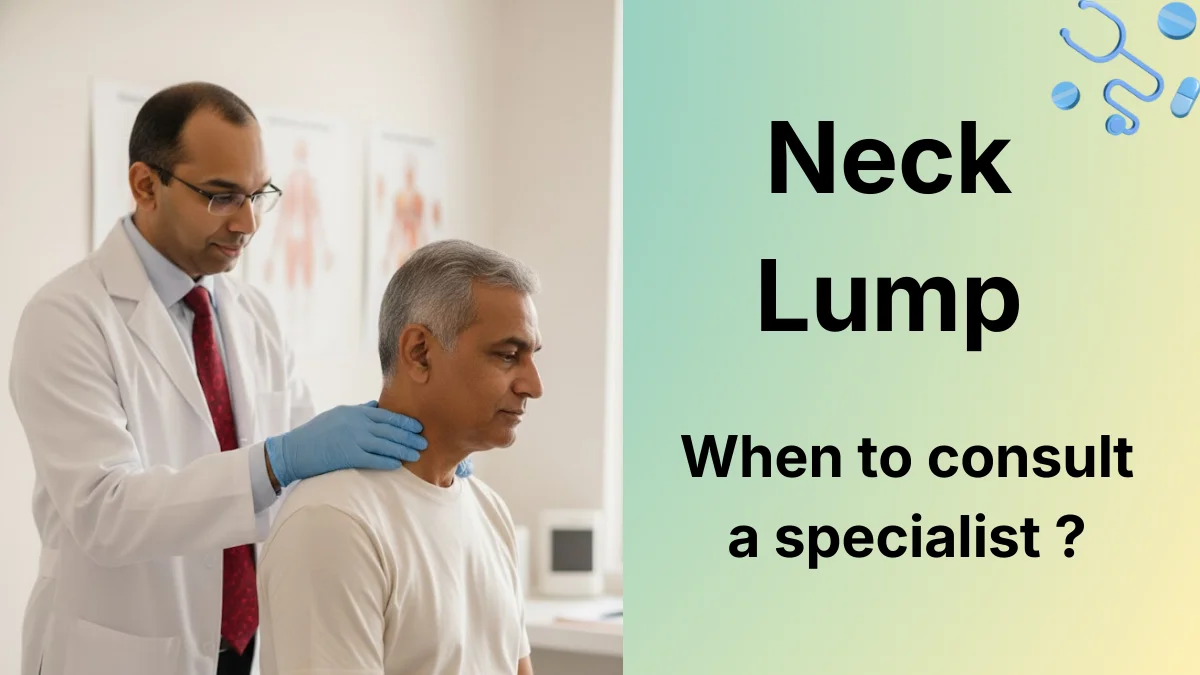
A lump that does not settle should be checked. Our guide explains when a neck lump is a concern.
Diagnosis at THANC Hospital
Dr. Vidhyadharan uses a simple, step-by-step work-up:
- Clinical examination of the gland, the floor of the mouth and the neck.
- Ultrasound scan to look at the gland and any stones.
- Fine-needle aspiration cytology (FNAC) if a tumour is suspected, to tell benign from malignant before surgery.
- CT or MRI in selected cases, for larger tumours or deep stones.
If stones are the only problem, a gland-sparing option may be possible. We explain this on our salivary stone removal page.
How the Surgery Is Done
The operation is done under general anaesthetic and usually takes about an hour. Dr. Vidhyadharan makes a small incision in a natural crease in the upper neck, below the jawline, where the scar will be well hidden.
The key part of the operation is protecting the three nearby nerves. He carefully finds and preserves the nerve that lifts the lower lip, the nerve that gives the tongue its sensation and taste, and the nerve that moves the tongue. With these protected, he removes the gland along with any tumour or stone inside it. A small drain may be placed for a day or two to prevent fluid building up, and the incision is closed in layers so the scar stays fine and discreet.
If the gland is being removed for cancer, the surrounding tissue and, if needed, the neck nodes are also addressed as part of the plan. For benign causes such as stones or repeated infection, only the gland is removed.
What to Expect
Before surgery. Examination, ultrasound and, if needed, FNAC. Dr. Vidhyadharan explains the plan and the risks.
Day of surgery. A short operation under general anaesthetic, often with an overnight stay.
Recovery. Most patients go home within a day. The drain, if used, comes out after a day or two. Most people return to normal activities within one to two weeks.
Recovery and Aftercare
- Wound care. The incision heals over one to two weeks. Stitches are removed at the first follow-up.
- Lip and tongue function. Any temporary weakness or altered taste is monitored and usually settles. Dr. Vidhyadharan checks this at each visit.
- Final result. The tissue is examined and the result is reviewed with you. For cancers, a follow-up plan is arranged.
Outcomes
For benign causes such as stones or infection, removing the gland resolves the problem and recovery is quick. For tumours, the gland and lump are removed and examined, and any further treatment is guided by the result. Protecting the nearby nerves means most patients keep normal lip movement, tongue movement and taste.
Why Choose Dr. Vidhyadharan at THANC Hospital
- Head and neck surgical oncology training. MCh (Head & Neck Surgery) and European Board certification (FEB-ORL HNS), with specific expertise in salivary gland surgery.
- Careful nerve protection for the lip and tongue nerves that run close to the gland.
- 3000+ head and neck operations, the kind of volume linked to better outcomes.
- Discreet, well-hidden incisions in a natural neck crease.
- Full support at THANC Hospital, with in-house imaging, pathology and an oncology team when needed.
This is part of our wider salivary gland and head & neck care.
Treatment Cost and Insurance
The cost depends on whether the cause is benign or malignant, the room category and the length of stay. Most major health insurers in India cover medically indicated surgery, including cashless treatment at empanelled hospitals. Eligible patients may also use government schemes such as Ayushman Bharat (AB-PMJAY) or the Tamil Nadu CMCHIS.
THANC Hospital gives a clear, itemised estimate during your consultation. To see Dr. Vidhyadharan Sivakumar, request an appointment online.